⚠️ The Problem
Hong Kong has a 0.1% stamp duty on stock transactions. This sounds small, but it compounds devastatingly for active traders.
Why This Destroys Mean Reversion
Mean reversion strategies require frequent trading. You buy oversold, sell overbought, repeat. Every trade costs 0.2%.
Even if you have a perfect strategy, the stamp duty consumes 50% of your capital per year.
📊 Annual Cost by Timeframe
| Timeframe | Trades/Year | Annual Cost | Monthly Cost | Daily Cost | Verdict |
|---|---|---|---|---|---|
| Daily | 250 | 50% | 4.2% | 0.20% | ❌ Impossible |
| 2-day | 125 | 25% | 2.1% | 0.10% | ❌ Very Hard |
| 5-day (weekly) | 50 | 10% | 0.83% | 0.04% | ⚠️ Challenging |
| 10-day | 25 | 5% | 0.42% | 0.02% | ✅ Viable |
| 20-day | 12 | 2.4% | 0.20% | 0.01% | ✅ Good |
| 30-day | 8 | 1.6% | 0.13% | 0.007% | ✅ Great |
📈 Backtest: Tencent Mean Reversion
We tested a simple mean reversion strategy on Tencent (0700) from 2015-2026: buy when price is >X% below 20-day high, sell when >X% above 20-day low.
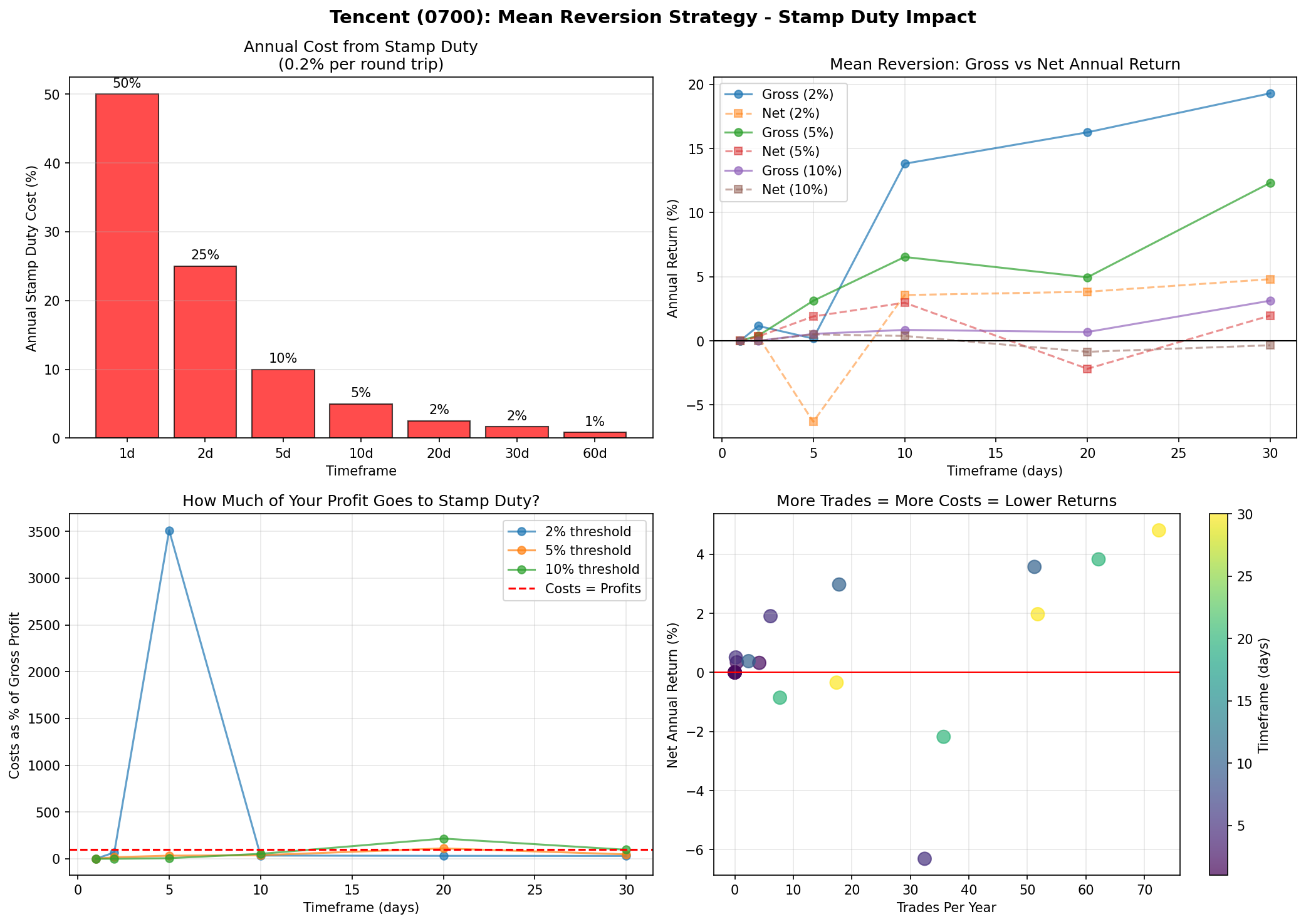
Results: 2% Threshold
| Timeframe | Trades | Gross P&L | Stamp Duty | Net P&L | Annual (Net) |
|---|---|---|---|---|---|
| 2-day | 48 | +14.2% | +9.6% | +4.6% | +0.3% |
| 5-day | 372 | +2.1% | +74.4% | -72.3% | -6.3% |
| 10-day | 586 | +339.7% | +117.2% | +222.5% | +3.6% |
| 20-day | 709 | +457.6% | +141.8% | +315.8% | +3.8% |
| 30-day | 721 | +478.9% | +144.2% | +334.7% | +4.8% |
🧮 The Mathematics of Survival
For mean reversion to work after stamp duty:
| Timeframe | Trades/Year | Required Return | Achievable? |
|---|---|---|---|
| Daily | 250 | 50% | ❌ Impossible |
| 5-day | 50 | 10% | ⚠️ Very Hard |
| 10-day | 25 | 5% | ✅ Challenging but possible |
| 20-day | 12 | 2.4% | ✅ Very achievable |
| 30-day | 8 | 1.6% | ✅ Easy |
🎯 Conclusions
✅ Mean Reversion CAN Work in HK
But only with weekly or monthly timeframes (10-30 day bars). At this scale, stamp duty becomes a manageable 1-5% annual cost.
⚠️ The Danger Zone: 5-day Trading
This timeframe looks attractive (weekly reversion) but requires 10% annual return just to break even on costs. Most strategies will fail here.
❌ Daily Scalping is Mathematically Impossible
250 trades/year × 0.2% = 50% annual cost. Even Warren Buffett can't generate 50% returns after this cost.
Recommendations for HK Mean Reversion
- Use 20-30 day bars minimum — reduces costs to 1.6-2.4%
- Combine with trend filter — reduce trade frequency
- Use wide thresholds — only trade extreme deviations
- Consider stamp duty refund stocks — some ETFs have lower costs
- Track costs separately — know your breakeven before trading
← Back to Timeframe Analysis | Main Page
Analysis using EODHD data | QuestDB | Python